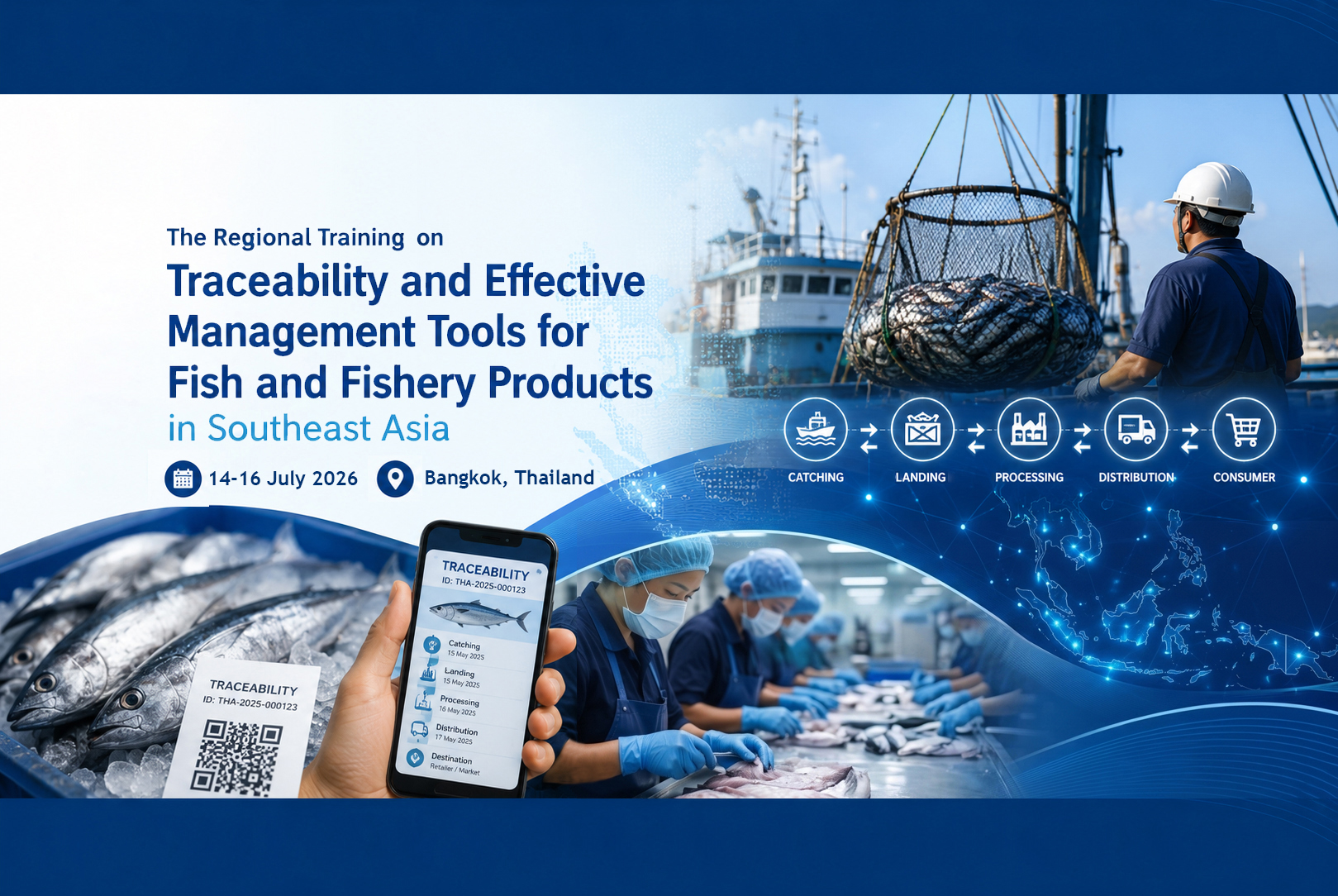

The Regional Training Course on Traceability and Effective Management Tools for Fish and Fishery Products in Southeast Asia
14 - 16 July 2026, Bangkok, Thailand
Introduction
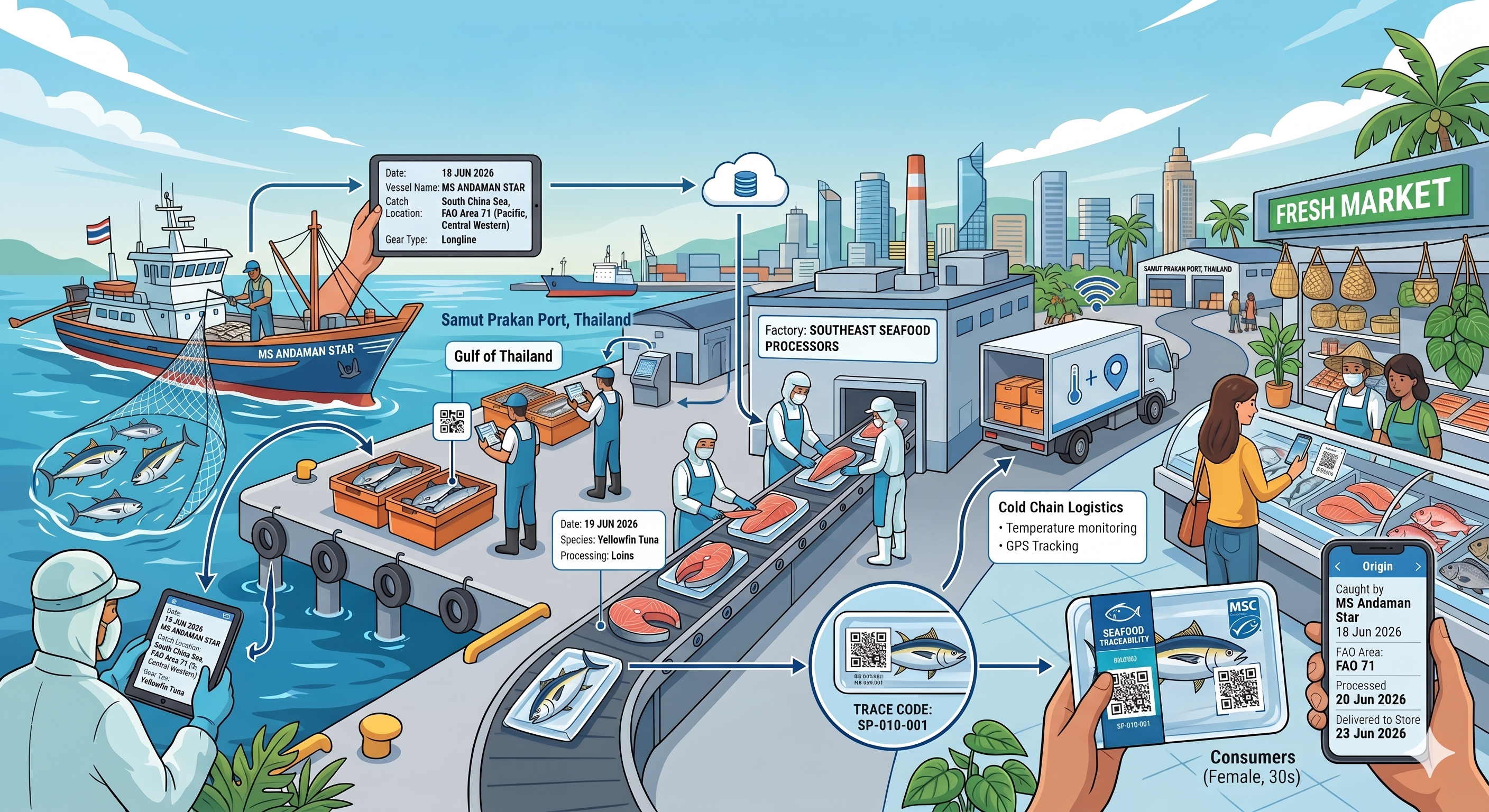
Fish and fishery products continue to rank among the most traded food commodities globally. In 2022, international trade amounted to 70 million tons, equivalent to 38 percent of total fisheries and aquaculture production. Over 200 countries and territories take part in aquatic trade during the year, compared to 150 in the mid-1970s. The global trade in aquatic animal products has seen substantial growth in value, with exports increasing from USD 7.9 billion in 1976 to a record high of USD 192 billion in 2022. This growth reflects an average annual increase of 7.2 percent in nominal terms and 4.0 percent in real terms. The total export value of all aquatic products reached USD 195 billion in 2022 (FAO, 2024).
Since 1976, Asia has demonstrated the highest average annual growth rate in the export value of aquatic animal products, followed by Africa, Europe, the Americas, and Oceania. In 2022, Europe and Asia maintained their positions as the leading exporting continents, accounting for 37 percent and 35 percent of the total export value, respectively (FAO, 2024).
Taking into account the significant contribution of fish and fishery products from Southeast Asian countries to the world market, the ASEAN Secretariat in cooperation with regional partners led by the Southeast Asian Fisheries Development Center (SEAFDEC) has strengthened regional initiatives for facilitating the sharing of experiences and information among the ASEAN Member States (AMSs) to enhance the respective countries’ capacities and efforts to deal with eliminating IUU fishing and market-driven measures. This was demonstrated when the AMSs adopted in 2016 “The Joint ASEAN-SEAFDEC Declaration on Regional Cooperation for Combating IUU Fishing and Enhancing the Competitiveness of ASEAN Fish and Fishery Products” to strengthen efforts in implementing regional initiatives to combat IUU fishing and promoted the “ASEAN Guidelines for Preventing the Entry of Fish and Fishery Products from IUU Fishing Activities into the Supply Chain,” endorsed by The 37th Meeting of The ASEAN Ministers on Agriculture and Forestry (The 37th AMAF) in 2015.
Read moreObjectives
Promoting traceability and effective management tools for fish and fishery products to eliminate IUU fishing in Southeast Asia.
Imparting the knowledge and sharing the lessons learned about existing traceability of fish and fishery products systems, including effective management tools inside and outside the region.
Expected outputs
Understanding the traceability of fish and fishery products to eliminate IUU fishing in Southeast Asia.
Increasing knowledge of the traceability of fish and fishery products from expertise inside and outside the region, and skills through lessons learned.
Timetable
3 days from 14 - 16 July 2026
Tuesday 14 July 2026
Time |
Activities |
Resource Persons |
08:30-09:00 |
Registration |
|
09:00-09:30 |
Opening Session
|
|
09:30-10:00 |
Refreshment |
|
10:00-12:00 |
Regional Traceability Tools for Fish and Fishery Products
|
Ms. Yanida Suthipol |
12:00–13:30 |
Lunch |
|
13:30–15:00 |
GDST Activities for Implementing Traceability Systems for Fish and Fishery Products |
Mr. Huw Thomas |
15:00−15:30 |
Refreshment |
|
15:30–16:30 |
Technology and Innovative Tools for Traceability at both Commercial and Small-Scale Levels |
Mr. Huw Thomas |
18:00–20:00 |
Reception Dinner |
|
Wednesday 15 July 2026
Time |
Activities |
Resource Persons |
09:00–10:30 |
Overviews of the Catch Document and Traceability System
|
Ms. Supinda Chongsuebsuk |
10:30-11:00 |
Refreshment |
|
11:00-12:00 |
Management and Control of Fish and Fishery Product Imports and Exports through Air, Land, and Other Transport Channels |
Mr. Set Kraitat |
12:00–13:30 |
Lunch |
|
13:30–16:30 |
Study the traceability system for fish and fishery products
|
Ms. Lia Sugihartini, Indonesia |
Thursday 16 July 2026
Time |
Activities |
Resource Persons |
09:00–10:30 |
Traceability for Mariculture |
Mr. Anucha Intana |
10:30-11:00 |
Refreshment |
|
11:00-12:00 |
Implementation of Traceability Systems in Fish Processing Plants |
Ms. Sarinna Chaisawat |
12:00–13:30 |
Lunch |
|
13:30–15:30 |
Discussion on Traceability Approaches and Frameworks for Small-Scale Fisheries to Combatting IUU in the ASEAN Region |
Facilitated by SEAFDEC/TD |
15:30–16:00 |
Closing Remark |
|
Download
Training Venue
Mandarin Hotel Bangkok
Bangkok, Thailand