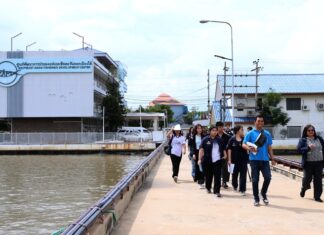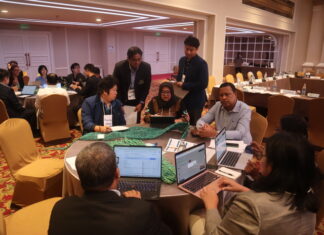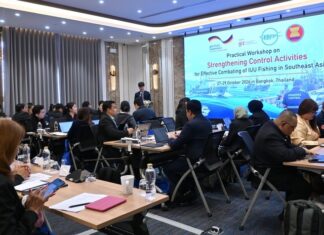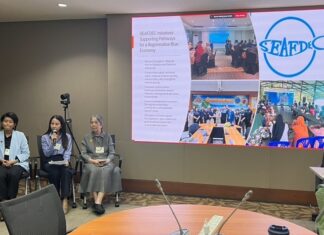



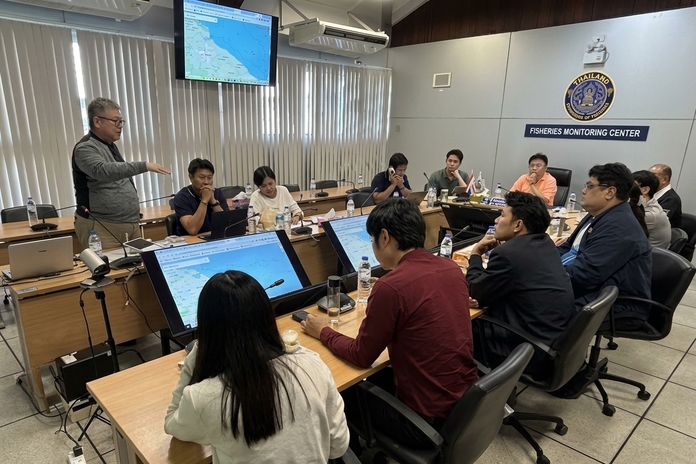
On 27 October 2026, the SEAFDEC Training Department (SEAFDEC/TD), in collaboration with the Department of Fisheries (DOF) of Thailand, held a technical meeting at the Fisheries and Fleets Management Division, DOF, to explore the Triton Vessel Monitoring System (VMS), developed by Ocean Solution Technology Co., Ltd. (OST), Japan. The meeting aimed to assess the system’s potential application to monitoring small-scale commercial fishing vessels measuring 10 to below 30 gross tonnage (GT) in Thailand. The meeting was chaired by Mr. Koichi Tahara, Deputy Chief of SEAFDEC/TD, with participation from DOF, SEAFDEC/TD, and the SEAFDEC Secretariat. Mr. Koichi Suga, Chief Operating Officer of OST, presented the system’s technical features and operational capabilities.
The presentation introduced the Triton Sphere terminal, a solar-powered vessel-tracking device designed specifically for fishing vessels. The device records vessel positions at 30-second intervals and stores location data for up to six months. It transmits tracking information through ELTRES and LTE communication networks, providing an alternative to conventional satellite-based VMS. Its design allows installation without direct wiring to the vessel’s electrical system and does not include a user-operated on/off switch.
In addition to vessel tracking, the system incorporates artificial intelligence (AI)-based analysis of vessel movement patterns to estimate fishing effort and support fisheries management. These capabilities could contribute to fisheries resource assessments, improve understanding of fishing activities, and assist authorities in identifying potentially unauthorized fishing in restricted areas. The system also includes a wearable SOS device that can send alerts when a crew member falls overboard, providing an additional safety function for fishing operations.
The meeting was conducted under DoF and SEAFDEC 2026–2028 study on alternative vessel-tracking systems for small-scale fishing vessels. The study aims to review available technologies, evaluate their technical performance and suitability under actual fishing conditions, and identify practical challenges and operational requirements. The findings will support the development of evidence-based recommendations for an appropriate, reliable, and cost-effective VMS solution for Thailand’s small-scale commercial fishing fleet.