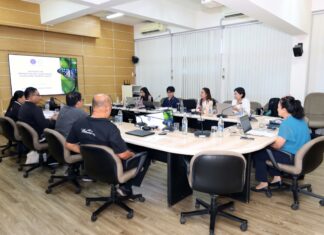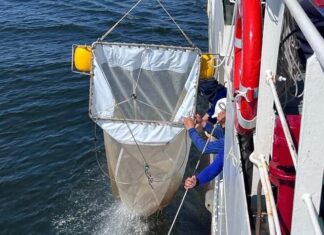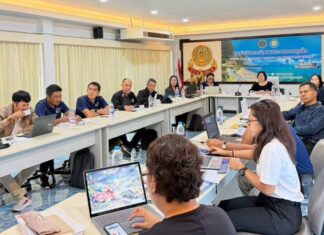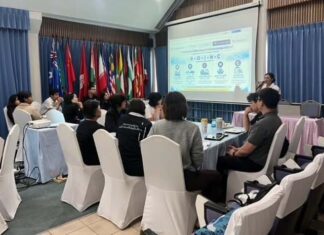


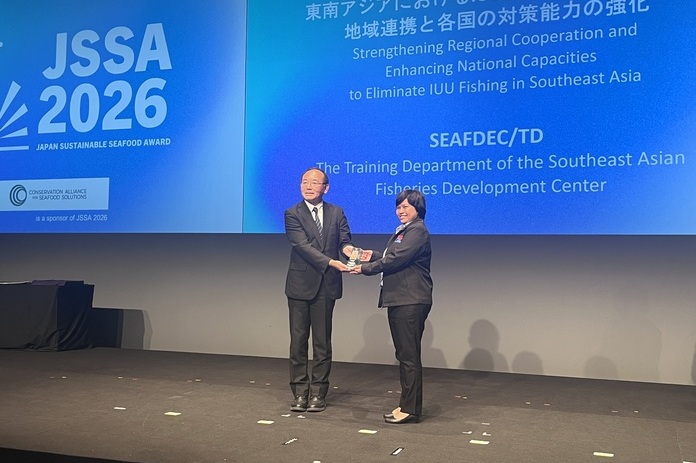
In a major milestone for regional marine conservation, the SEAFDEC Training Department (SEAFDEC/TD) project “Strengthening Regional Cooperation and Enhancing National Capacities to Eliminate IUU Fishing in Southeast Asia” was crowned the Champion Award Winner in the Asia Category on 21 October 2026 at the prestigious 7th Japan Sustainable Seafood Awards (JSSA 2026). The award ceremony was held as a flagship highlight of the Tokyo Sustainable Seafood Summit 2026 (TSSS 2026) in Tokyo, Japan.
On this momentous occasion, Ms. Namfon Imsamrarn representative of project team presented the implementation journey and transformative achievements of the five-year initiative (2020–2024), which was supported by the Japanese Trust Fund (JTF) to assist ASEAN Member States (AMSs) in combating Illegal, Unreported, and Unregulated (IUU) fishing. The award-winning project established a unified, tech-driven defense against IUU fishing across Southeast Asia. Key accomplishments recognized by the award committee include, 1) modernized regional enforcement: training over 800 fisheries personnel and inspectors in Monitoring, Control, and Surveillance (MCS) operations and Port State Measures (PSM), 2) enhanced fleet transparency: populating the Regional Fishing Vessels Record (RFVR) database with 5,370 self-updated large-scale vessels using 28 Key Data Elements, and 3) sea-to-plate traceability: developing and deploying the electronic ASEAN Catch Documentation Scheme (eACDS) prototype, securing seafood supply chains against illicit catches. By successfully integrating these digital tools and cross-border protocols, the project choked out illegal catches from markets, safeguarded marine ecosystems, and secured regional food security and coastal livelihoods—laying a resilient foundation for future expansion.
The delegation from SEAFDEC/TD included three key staff members responsible for anti-IUU fishing operations who attended TSSS 2026 from 21 to 23 October 2026. Organized by Seafood Legacy and Nikkei ESG under the theme “Resonating Actions, Scaling Impact,” the summit brought together international leaders across industry, government, and civil society to turn community-rooted seafood conservation efforts into scalable, mainstream practices by 2030.