


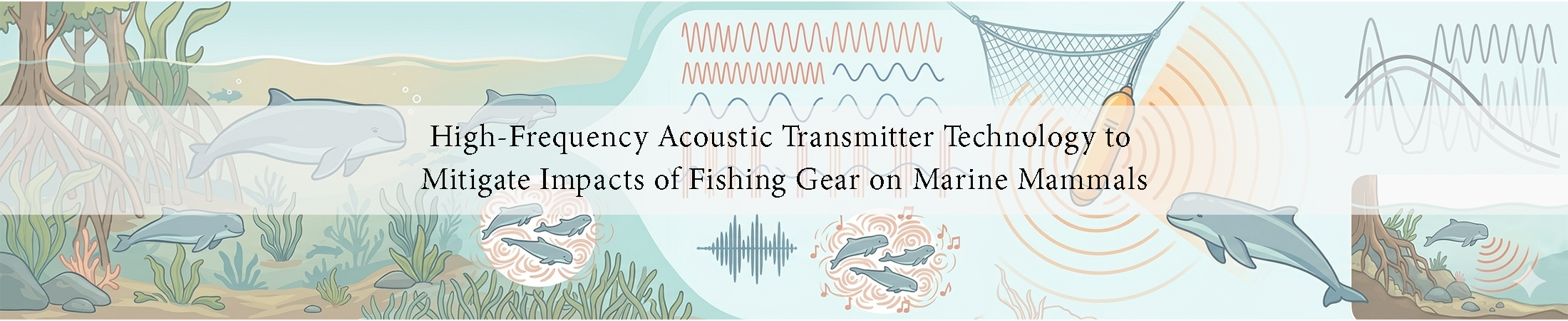
What is …High-Frequency Acoustic Transmitter Technology to Mitigate Impacts of Fishing Gear on Marine Mammals And why use it?
Some problems with dolphins in ThailandThere was a time when Songkhla Lake was alive with them. Over 100 Irrawaddy dolphins (Orcaella brevirostris) once called these waters home. By 2024, only 13 individuals will remain (Seub Nakhasathien Foundation, 2024). That’s fewer than the number of people at a dinner table. The collapse has been swift and devastating. From over 100 individuals recorded in the 1990s (Beasley et al., 2002), the population fell to just 27 by 2015 (DMCR, 2022), then to 16 in 2021, and now to only 13 in 2024. And the cause isn’t a mystery. Entanglement in fishing gear, particularly gillnets, accounts for over 65% of all stranding cases (DMCR, 2021), meaning the majority of these dolphins aren’t dying from disease or old age. Thirteen individuals stand between survival and silence.
Acoustic Deterrent Devices (Pingers)
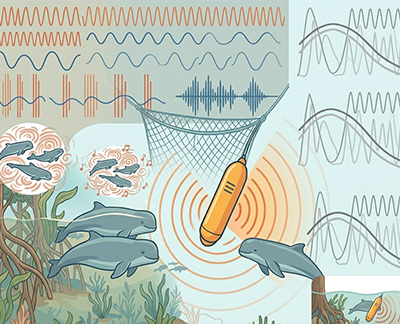
Acoustic deterrent devices, or pingers, are a practical application of High-Frequency Acoustic Transmitter Technology, designed specifically to mitigate the impact of fishing gear on marine mammals. By emitting High-frequency signals (50–120 kHz) directly from nets, pingers exploit the dolphin’s natural acoustic sensitivity to trigger avoidance behaviour before entanglement occurs.
How can pingers help?
Pinger technology represents a targeted, non-invasive solution that can be implemented without reducing fish catch or disrupting fishing livelihoods. Evidence from Omeyer et al. (2020) demonstrated that harbour porpoises were 37% less likely to be detected near active pingers, suggesting that cetaceans actively avoid nets when acoustic warning signals are present, thereby reducing the likelihood of entanglement.