


Thailand’s Fisheries Context
Thailand is one of Southeast Asia’s leading fisheries producers, with marine capture fisheries central to national food security, employment, and economic development. While much attention focuses on harvesting efficiency, post-harvest handling and unloading practices are equally decisive in setting the final quality and market value of landed catches.
Why Fish Unloading Matters
Unloading is the crucial transition between onboard preservation and shore-based distribution moving fish from vessels to landing sites, auctions, processing plants, and transport. Done well, it protects the freshness and value created at sea.
Risks of improper handling
- Temperature fluctuations breaking the cold chain
- Physical damage and bruising of the catch
- Contamination and reduced food safety
- Quality loss, lower value, higher post-harvest losses
Four Unloading Methods at a Glance
Thai vessels range from traditional manual labor to mechanized, lower emission systems chosen by vessel type, gear, catch volume, and port infrastructure.
1 Manual Plastic Crates: Hand-carried crates on small & medium vessels
2 Mechanical Winch: Engine-powered side winch lifts cylindrical containers
3 Electric Winch Onboard: Powered deck hoist on purse seiners
4 Electric Conveyor: Zero-emission transfer of trash fish to trucks
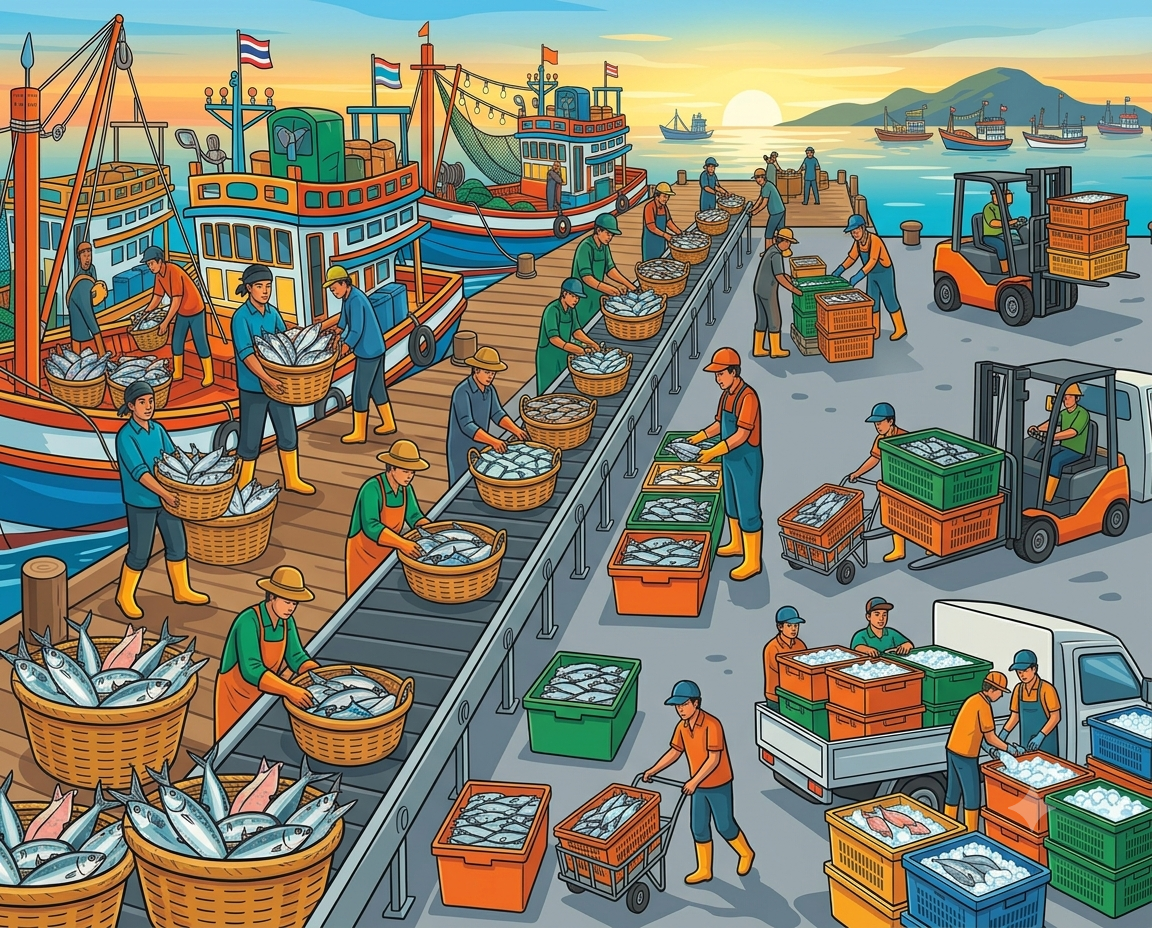
Manual Unloading from Plastic Crates
Fish are sorted and packed onboard into plastic crates layered with crushed ice (0 to 4 °C) and stacked neatly in the hold. Unloading is done by hand, without the engine running.
How it works
-
- Crew open the fish hold lids and prepare the receiving area on shore
- Crates are lifted by hand from the hold up to the deck
- Crates are passed in stages from the deck down to the dock
- Shore workers weigh, sort, and pour the fish for sale
- Work fast, avoid direct sun, top up ice, and keep the dock clean