

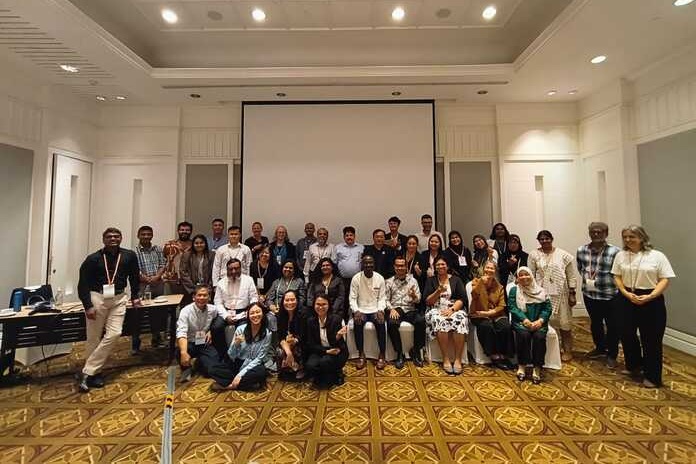
The Southeast Asian Fisheries Development Center (SEAFDEC), under the BOBLME II Project, supported nine representatives (7 females and 2 males) to participate in the “Seas of Change: Shared Insights for Supporting Small-Scale Fisheries in the Gulf of Thailand and Bay of Bengal” meeting, convened by the Food and Agriculture Organization of the United Nations (FAO) on 26 April 2026 in Hua Hin, Prachuap Khiri Khan, Thailand. This was followed by their participation in the 5th World Small-Scale Fisheries Congress (5WSSFC), held from 27 April to 1 May 2026 at the same venue. The Congress was co-hosted by TBTI Global in collaboration with its global network of hubs and partner organizations.
The delegation was led by Ms. Panitnard Weerawat, Head of the Research and Development Division of SEAFDEC/Training Department (TD) and included SEAFDEC/TD staff and representatives from Indonesia, Malaysia, and Thailand.
The “Seas of Change” meeting brought together practitioners from the BOBLME II and GoTFish projects to exchange experiences and align priorities for supporting small-scale fisheries across the Gulf of Thailand and Bay of Bengal. Through discussions and group work, participants identified key lessons and explored opportunities for collaboration on transboundary governance, ecosystem approaches to fisheries management (EAFM), and addressing illegal, unreported and unregulated (IUU) fishing. The meeting also highlighted linkages with ecological connectivity and the blue economy.
On 28 April 2026, project-supported country representatives contributed as speakers in a session titled “Advancing Small-Scale Fisheries Sustainability through Ecosystem Approaches and Governance Measures: Lessons from the Gulf of Thailand and Bay of Bengal,” attended by over 50 participants. The session emphasized the importance of sub-regional cooperation, ecosystem-based approaches, and value chain incentives, supported by coherent governance frameworks to enhance the sustainability and resilience of small-scale fisheries.
These activities were conducted under the BOBLME II Project, implemented by FAO in partnership with IUCN, BOBP-IGO, and SEAFDEC, with financial support from the Global Environment Facility (GEF) and the Norwegian Agency for Development Cooperation (Norad).