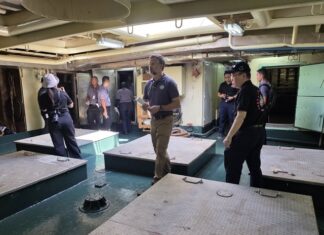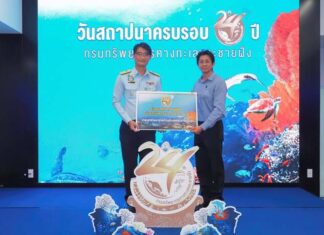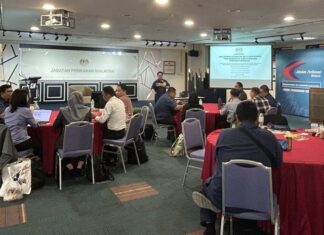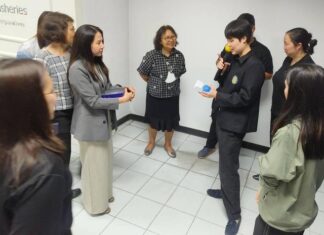



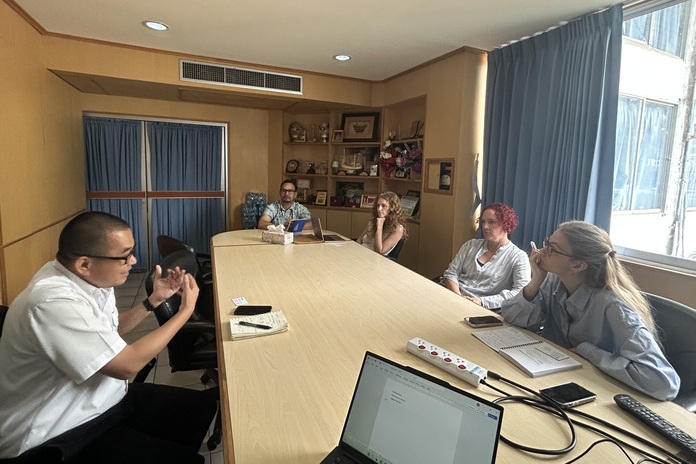
On 12 March 2026, representatives from the International Labour Organization (ILO), led by Linnéa Strand and accompanied by Dallakoti Gunjan, Hanson Valkyriea, and Milliken Mattie, visited the Southeast Asian Fisheries Development Center (SEAFDEC).
The Secretary-General of SEAFDEC assigned Mr. Isara Chanrachakig and Ms. Suwanee Sayan from the Project Planning and Management Division of SEAFDEC/TD to represent SEAFDEC in exchanging information on the implementation of the BOBLME II Project in collaboration with the Bay of Bengal Programme Inter-Governmental Organization
(BOBP-IGO) and the International Union for Conservation of Nature (IUCN). A total of six (6) participants
(4 females and 2 males) attended the meeting. Under the project arrangement, SEAFDEC oversees activities in Thailand, Malaysia, and Indonesia, while BOBP-IGO manages implementation in Bangladesh, India, Maldives, and Sri Lanka.
The discussion highlighted key project priorities, including promoting the Ecosystem Approach to Fisheries Management (EAFM), addressing illegal, unreported and unregulated (IUU) fishing, improving port management and fishing gear marking to reduce marine pollution, and enhancing the resilience of coastal communities to climate change.
The meeting also emphasized the role of technological innovation and capacity building, such as introducing mechanical hauling devices to reduce labor demands on fishing vessels and promoting solar-powered ice preservation, alongside training programs organized by SEAFDEC to strengthen the capacity of fisheries stakeholders in the region.
During the discussions, it was noted that while issues such as human trafficking and forced labor remain important concerns in the region, labor inspections and human rights enforcement fall under the jurisdiction of national governments and relevant organizations. Therefore, activities under TD therefore focus on technical cooperation and appropriate technologies to support sustainable fisheries operations, improve livelihoods and safety at sea for fishers. In addition, with the recent expansion of maritime zones in Bangladesh, future activities will also support capacity building for deep-sea tuna fishing and maritime safety in the region.