


Event Overview
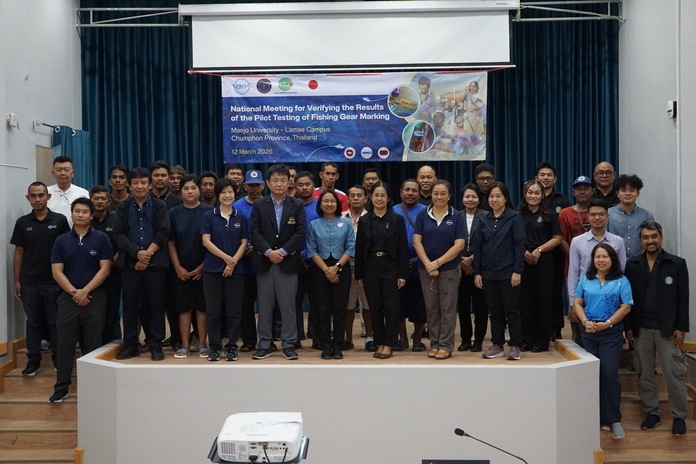
On March 12, 2026, the Southeast Asian Fisheries Development Center (SEAFDEC) hosted the “National Meeting for Verifying the Results of the Pilot Testing of Fishing Gear Marking” at Maejo University’s Lamae Campus in Chumphon Province, Thailand. This event was made possible through support from the Japan-ASEAN Integration Fund (JAIF) and represented a collaborative effort between SEAFDEC’s Training Department (SEAFDEC/TD) and the Department of Fisheries (DOF) Thailand.
Bringing Research to the Real World
The primary goal of the meeting was to validate the outcomes of pilot tests conducted in Chumphon Province from mid-January to late February 2026. SEAFDEC Secretary-General Sampan Panjarat emphasized in her opening remarks that the initiative aims to move beyond theoretical discussions by evaluating how different marking systems function under real marine conditions.
Pilot Phase and Materials Tested
During the pilot phase, technical teams focused on assessing three specific marking materials:
• Bird rings
• Plastic tags
• Metal tags
The Four Pillars of Evaluation
The effectiveness of these marking systems was measured against four essential criteria:
1. Practical Feasibility: Evaluating how easily the marks can be implemented within the local fishing context.
2. Cost-Effectiveness: Ensuring the materials are financially viable for fishers.
3. Durability: Testing the resilience of the marks to harsh marine environments, weather, and seawater.
4. Acceptance and Cooperation: Securing the support and active participation of local fishers, who are the end-users of the technology.
A Collaborative Approach
To ensure the findings were robust and practical, 41 key stakeholders attended the verification meeting. Participants included 18 officials from DOF Thailand, experts from marine research centers, technical resource persons, and 10 local fishers who had participated in the field testing. This diverse group helped guarantee that the solutions developed would be applicable and beneficial for the fishing community.
Looking Forward: A Regional Standard
Implementing Fishing Gear Marking (FGM) is crucial for addressing the global issue of Abandoned, Lost, or Discarded Fishing Gear (ALDFG), enhancing traceability, and combating Illegal, Unreported, and Unregulated (IUU) fishing.
Conclusion
In his closing remarks, Mr. Koichi Tahara, SEAFDEC Deputy Secretary-General, noted that the brainstorming and data verification during the meeting paved the way for clearer future action by adapting international standards such as the FAO Voluntary Guidelines on the Marking of Fishing Gear (VGMFG) to suit Thailand’s specific needs. This project is expected to benefit Thailand and contribute to sustainable fisheries management across the ASEAN region.